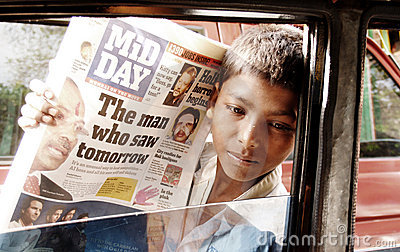
As had been customary for pretty much the entire summer, 11-year
old Amir woke up at around seven in the morning drenched in sweat. The fan had
been still for almost three consecutive days now; a silent reminder of the
bliss it had been that Amir had never bothered to acknowledge when electricity
would visit their home a few hours a day. His mother was stretched out next to
him; asleep; the fanning mat still clutched in her hand. She had fanned him to
sleep, Amir knew, and had finally given in to exhaustion and dropped off
herself. Her sleep wouldn’t last long, Amir knew. The heat would see to that.
Soon he was out on the streets, in
the scorching heat with the stack of newspapers balanced under his arm. He
didn’t have to try hard to appear in a pitiful state as he shuffled from car to
car, waving the newspapers in the car windows; his grubbed and torn-at-places
attire, matted hair and dirty face saw to that. Whether a disgraceful
appearance helped him in selling more newspapers or not was a debate he had
forgone a long time ago. There was just no satisfying people, he knew. If he
made himself look abject, people might take pity on him, but would mostly just
turn away in disgust. If he made himself look presentable, there would be no
end to the ‘such a fine young lad you are, and look at you. Begging here on the
streets (even though that wasn’t exactly what he would call selling
newspapers), why don’t you go out and get a real job?’ stereotypes.
In his scrimpy trade, Amir had come
across a lot of different types of people. There were the big, rich businessmen
who would ride up in their big black cars, seated in the backseat clad in grand
suits. Such people hardly ever bothered to even look up at him. There was the
harried father rushing his kids to school, always in bad mood. Often he would
vent out his anger on Amir. There were youngsters, whos’ arrival would always
be heralded by loud music blaring from the car speakers. Whenever he approached
them, they would engage in a loud and raucous discussion, and pretend not to
hear him. There were taxi drivers; always mopping their sweating foreheads; and
most of them hardly had enough for their own selves, yet would at times try to
shell out whatever they could for him. Very few were the relaxed people, who
would smile whenever he came up and pay him, and sometimes they would even
refuse the newspaper he offered them, telling him to just keep the money.
Rejection was an integral part of
Amir’s ‘trade’. He had learned long ago not to let it get him down. And so he
had stopped seething at people who would roll up their windows when they
spotted him, or the disdainful looks he received, or the snide comments about
how he was a perfectly healthy young boy who should do something more
worthwhile than selling newspapers. He had even stopped being frustrated at the
selfishness of the people; after all, if a person could afford a big car, an
expensive mobile phone, maintain a family, why could he not shell out a mere 10
rupees to him, a person in dire need? It was something that used to bother him
a lot once; when every window rolled up in his face, or every annoyed
expression on a potential customer’s face when he ambled along would be an
affront to him, and he would turn away with a sickening feeling in his stomach,
his heart aching. It wasn’t just the fact that they were forcing him to move on
empty-handed, but also the contempt with which they regarded him. He may not be
educated, or have a proper job, or own a car, but he was still human. He too
had feelings! But as the days rolled by without anything changing, he learned
not to let it get him down. Sometimes he told himself to be strong; at other
times, he would compare himself with shopkeepers. He told himself that while he
may not have a proper shop, he had the freedom of being able to interact with
his customers openly and freely, and he did not have to worry about competition
either. Of course, he did not get the respect that shopkeepers get in his case,
but after all, you have to give something to lose something. Sometimes he would
realize how ridiculous he was being, but he forced himself to believe that, for
he needed a way to uphold his pride. He had some of it, if not a lot, and like
every other person, he needed to maintain it. To keep himself going.
But despite whatever he kept
telling himself, the fact remained that rejection wasn’t just in his ‘trade’;
it was in Amir’s whole life. He had been rejected a father who could
financially support his family. He had been denied a country which could, or
maybe chose to, help people like him all over the country. He had been denied
the basic necessities of life such as water and electricity. He had been denied
an education. In short, he had been denied a proper life.
He had even been denied a healthy
mother. She was sick most of the time; sprawled on the bed, her skin burning to
the touch. Fear and worry for her made Amir forget all about his misfortunes
though. Amir didn’t know exactly what she was suffering from, but he was aware
that they never had enough money to get her treated properly. Amir had even
started to save up the small amount he used to shell aside from his income every
day for sweets and chocolates, in the hope that one day he could gather enough
to get his mother treated. He loved her so very much; the pure love born of
innocence that exists between a mother and child; and he didn’t know what he
would do without her.
And that, in fact, was his true driving
force; not him telling himself to be strong, neither the need to uphold his
pride; it was fear for his mother. It was what kept him doggedly padding
through the roads, stopping at car after car, waving his newspapers in the
windows, steeling his nerves at every rejection, and moving on. That, and of
course his self-assurance that this was still better than being stuck at a
shop, being forced to sit the hours away. It was something Amir knew, deep
down, yet he refused to acknowledge it, and kept telling himself it wasn’t
true. Because it would always lead him to thoughts of what would transpire if
something were to happen to his biggest source of inspiration; if she was
around no more; what would he do then?
And then he would shake his head; telling
himself that he was being foolish, for nothing was going to happen to his
mother, and that he would soon have enough money to get her properly treated;
and then he would move on to wave his stack of newspapers in the next car’s
window.